

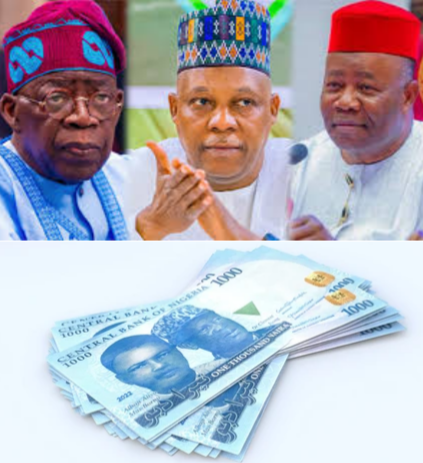
The Federal Government is considering a review of salaries for top political office holders, including President Bola Ahmed Tinubu, Vice President Kashim Shettima, ministers, senators, and other high-ranking officials.
This was disclosed by the Chairman of the Revenue Mobilisation Allocation and Fiscal Commission (RMAFC), Mohammed Shehu, during a press briefing in Abuja on Monday. He noted that the current salary structure, which has remained unchanged since 2008, no longer reflects the realities of governance in Nigeria.
“You cannot pay the President of Nigeria ₦1.5 million monthly in a country of over 200 million people and expect it to be taken seriously,” Shehu said.
- VIDEO: Woman Claiming to Be Chris Okafor’s Former Wife Makes Explosive Allegations
- I will not be vice-president to anybody ~ Peter Obi
- Israel recognises Somaliland as sovereign state
- 70-year-old Indian woman gives birth to her first child
- Ghanaian Prophet, Eboh Noah, Builds 8 Arks, Reveals God Has Warned Him That The World Will End On Christmas Day ~ Not By Fire, But By Another Global Flood.
- VIDEO: Pregnant wife bursts into tears as husband refuses to go beg neighbour Jollof rice
He also highlighted the disparity in earnings between political leaders and heads of government agencies, pointing out that some directors-general and the CBN governor earn several times more than the President and the Attorney-General of the Federation. According to him, this imbalance erodes the dignity of public office and distorts the national pay system.
The move, however, has drawn sharp criticism from the Nigeria Labour Congress (NLC), which described it as insensitive and unjust. The union argued that it would be wrong to increase the earnings of politicians while ordinary citizens battle with inflation, subsidy removal, and the rising cost of living.
“How can leaders be considering salary increments for themselves when millions of workers and citizens can barely afford basic necessities?” the NLC queried.
The debate comes at a time of mounting economic pressure on households across the country, with public frustration over hardship continuing to dominate national conversations.