

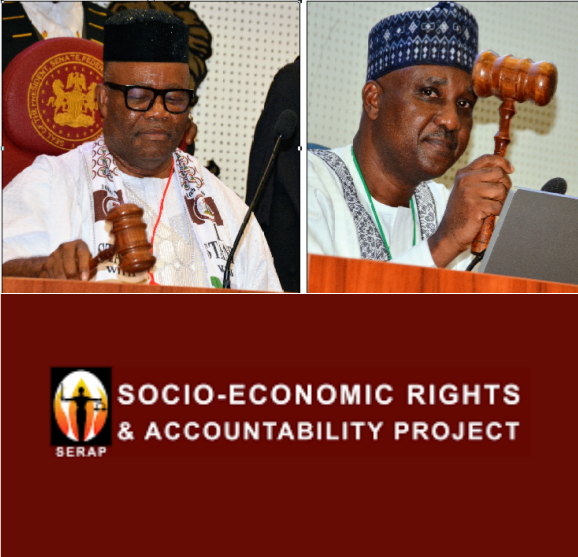
The Socio-Economic Rights and Accountability Project (SERAP) has taken Senate President God’swill Akpabio and House Speaker Tajudeen Abbas to court over their alleged refusal to account for ₦18.6 billion released for the construction of the National Assembly Service Commission (NASC) office complex.
The suit, filed at the Federal High Court in Abuja (FHC/ABJ/CS/2457/2025), also lists the NASC as a respondent. SERAP argues that findings from the 2022 Auditor-General’s report suggest that a large portion of the funds may have been misused, including payments made to a company described as “unknown” in the report.
- VIDEO: Woman Claiming to Be Chris Okafor’s Former Wife Makes Explosive Allegations
- I will not be vice-president to anybody ~ Peter Obi
- Israel recognises Somaliland as sovereign state
- 70-year-old Indian woman gives birth to her first child
- Ghanaian Prophet, Eboh Noah, Builds 8 Arks, Reveals God Has Warned Him That The World Will End On Christmas Day ~ Not By Fire, But By Another Global Flood.
- VIDEO: Pregnant wife bursts into tears as husband refuses to go beg neighbour Jollof rice
SERAP is asking the court to compel Akpabio, Abbas, and the NASC to explain how the ₦18.6 billion was spent, reveal the identity of the contractor involved, and release all procurement documents tied to the project, such as bid records, approvals, and contract agreements.
The group maintains that the alleged diversion violates the Constitution and undermines public trust. It insists that Nigerians deserve clarity on how the funds were used, adding that transparency would strengthen confidence in the National Assembly’s ability to manage public resources responsibly.
According to the Auditor-General, over ₦11.6 billion was paid to a contractor in 2020 for a 24-month construction job allegedly inflated by ₦6.9 billion. Another payment was reportedly made in 2023 for converting a roof garden to office space, without bidding, assessment, or Federal Executive Council approval.
SERAP argues that accountability is necessary to curb corruption and protect public funds. The court has not yet fixed a date for hearing.