

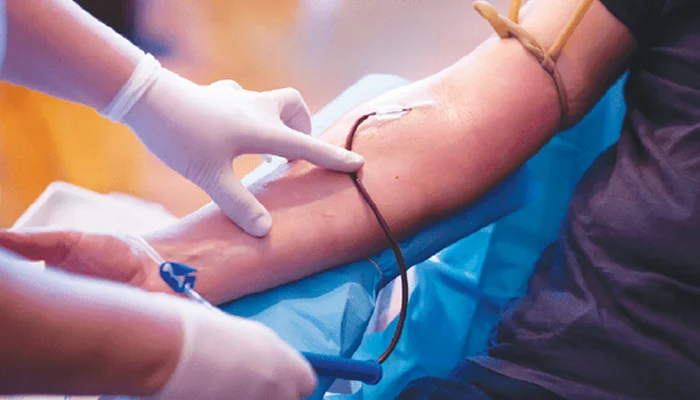
A 23-year-old lady, Josephine, has turned blood donation into a profession. Not the voluntary kind but a paid, underground trade she relies on for survival.Her involvement in this illicit practice has continued to worry many, especially those who fear that, as a woman who already loses blood monthly, she is placing herself in grave danger.Driven by hardship, Josephine ignores medically safe limits, which permit no more than three to four donations a year.
Instead, she donates repeatedly at various hospitals and small clinics in exchange for quick cash, a routine that is risky, largely unsupervised and harmful to her long-term health.The soft-spoken school leaver is always ready to part with her blood for the right price, regardless of the hospital or location. What she charges per pint, she said, depends on the urgency of the request and where the patient is being treated.“I can donate, but not three pints. I can only give you two,” Josephine told our correspondent, who posed as someone seeking blood for an emergency surgery. When asked whether she could help arrange another donor to make up the third pint, she explained her predicament.
The people I work with don’t have my type. My genotype is AA, and blood group is O+. It may take a while to find someone. For mine, I collect N120,000 per pint. So, two will be N240,000.”After negotiation, she agreed to N80,000 per pint, noting that the last donation she made two months earlier was for the same amount. When questioned about why she charged so much when blood banks sell for about N30,000, she said, “It depends on the hospital and the location. Some hospitals don’t want stored blood; they insist on fresh blood, and getting people immediately is hard. Some blood groups are costlier than others, especially the negative ones. We also buy drugs and supplements to boost our blood, so we add that to the cost.”Josephine is well known at Shiroma Hospital in Lagos. She entered this dangerous “business” in 2020, shortly after completing her WAEC, driven by poverty, unemployment, and the urgent need to raise money for her university education.With her parents, who are petty traders unable to support her and her four siblings, she sought a way out.One day, after noticing that families often paid for blood during emergencies, she approached the hospital security guard, who linked her to a nurse.“I told her I wanted to donate so they could give me the money they use to buy blood,” she said. “She checked my blood pressure and ran some tests. They took my blood, and I almost fainted. My eyes went blank. She gave me milk and malt, and after resting, I felt a bit better. Before I left, I dropped my number and told her to call me anytime someone needed O+. That’s how I entered the business.”Despite medical advice that donors should wait at least three to six months for the body to replenish lost blood, Josephine continues to donate as often as she is paid. According to the National Blood Services Agency, males should donate only every three months and females every four, limits she surpasses easily.